


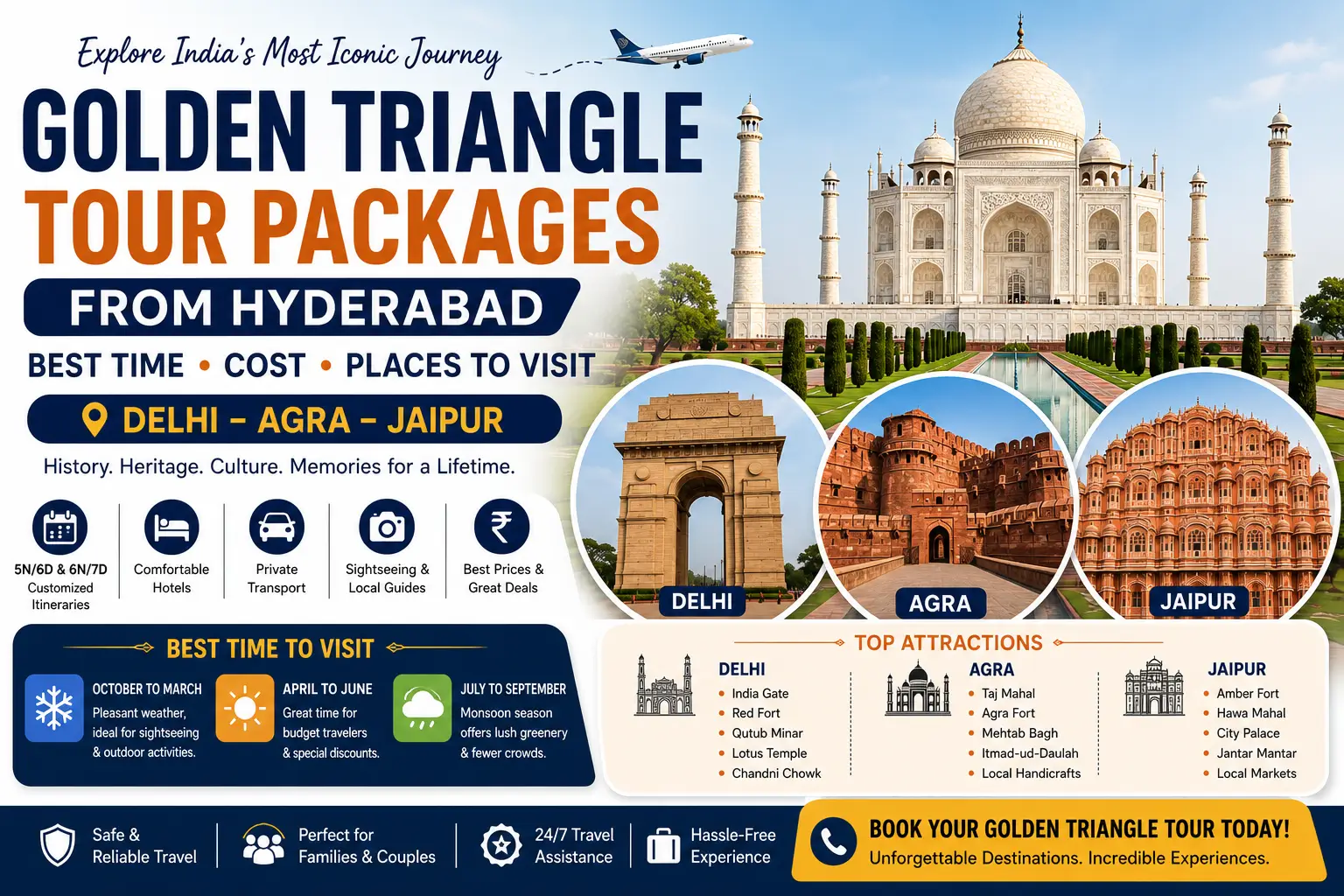
Golden Triangle Tour Packages from Hyderabad: Best Time, Cost and Places to Visit
A 6-day Golden Triangle trip from Hyderabad costs ₹18,000–₹60,000+ per person depending on hotel category, covering Delhi, Agra, and Jaipur. October–March is the best travel window. One scheduling detail that catches people out: the Taj Mahal is closed every Friday — so if your itinerary has an Agra day landing on a Friday, move it before you book anything else.
Covering Delhi, Agra, and Jaipur, the Golden Triangle is India's most popular travel circuit, combining Mughal architecture, Rajput forts, street food, and shopping within a compact, well-connected route. With frequent flights from Hyderabad to Delhi and a road circuit that's genuinely easy to navigate, it's one of the simplest multi-city trips to plan in India.
The Friday Rule: Plan Your Agra Day Around It
This deserves its own section because it's the single most common planning mistake on this circuit:
- The Taj Mahal is closed to tourists every Friday, opening only for namaz at its mosque. Visitors who arrive on a Friday without checking are turned away at the gate.
- Agra Fort, Fatehpur Sikri, and Mehtab Bagh remain open on Fridays — so a Friday in Agra isn't wasted, but the main attraction is off the table.
- Night viewing (8:30 PM–12:30 AM) is available on the full-moon night plus two days either side, but not on Fridays or during Ramzan, and requires a separate ASI ticket booked in advance.
Practical fix: structure your itinerary so the Agra day falls Saturday through Thursday, and if your travel dates are fixed and Friday is unavoidable, swap the Delhi and Agra days around.
Entry Fees You Should Budget For (Indian Citizens)
Most packages quote hotels and transport but leave monument entry as a separate line — here's what to actually expect:
| Monument | Entry Fee (Indian citizens) |
| Taj Mahal | ₹50 (+ ₹200 extra for the main mausoleum chamber) |
| Agra Fort | ₹50 |
| Fatehpur Sikri | ₹50 |
| Itimad-ud-Daulah (Baby Taj) | ₹30 |
| Mehtab Bagh | ₹25 |
Worth knowing: children under 15 enter free at all ASI monuments, booking Taj Mahal tickets online saves ₹5 per Indian ticket, and the ₹200 mausoleum chamber ticket is generally considered worth paying rather than skipping. Battery bus from the gate to the monument runs ₹50–80 per person round trip, since it's roughly a 1 km walk otherwise.
Best Places to Visit
Delhi
Delhi combines Mughal-era monuments, colonial-era architecture, and modern city life within a compact area, and works well as both your arrival point (best flight connectivity from Hyderabad) and your first sightseeing stop.
- Red Fort — The Mughal capital's main residence for nearly 200 years, built by Shah Jahan (the same emperor behind the Taj Mahal). A UNESCO World Heritage Site, and the site of India's annual Independence Day address. Closed Mondays.
- Qutub Minar — A 73-metre brick minaret dating to the early 13th century, the tallest of its kind in the world, surrounded by ruins of Delhi's earliest Islamic architecture including the famous non-rusting Iron Pillar.
- Humayun's Tomb — Often described as the architectural predecessor to the Taj Mahal, built in the 1560s and the first major Mughal garden tomb in India. Worth visiting before Agra rather than after, since the design lineage is easier to appreciate in that order.
- India Gate — A 42-metre war memorial commemorating Indian soldiers who died in World War I; best visited in the evening when the surrounding lawns are lit and busy.
- Jama Masjid — One of India's largest mosques, also commissioned by Shah Jahan, with a courtyard that holds around 25,000 people. Modest dress required; the climb up the southern minaret offers a good view over Old Delhi.
- Chandni Chowk — Old Delhi's main market street, best explored on foot or by cycle rickshaw. This is where the street food is — Paranthe Wali Gali specifically is worth the detour.
- Lotus Temple and Connaught Place — The Baha'i House of Worship (closed Mondays) and Delhi's colonial-era commercial hub respectively, both easy half-hour to hour stops.
Agra
The Taj Mahal is the obvious highlight, but Agra genuinely rewards a fuller day than most itineraries allocate.
- Taj Mahal — Built by Shah Jahan between 1631 and roughly 1648 in memory of Mumtaz Mahal, employing around 22,000 artisans. Sunrise is genuinely worth the early start — the marble changes colour in early light, and crowds are noticeably thinner than the 10 AM–1 PM window when Delhi day-trip groups arrive. The complex includes the mausoleum, a mosque, a guest house, and formal charbagh gardens.
- Agra Fort — A UNESCO-listed red sandstone fortress about 2.5 km from the Taj, where Shah Jahan was later imprisoned by his son Aurangzeb, reportedly with a view of the Taj from his quarters. Open on Fridays, which makes it the natural substitute if your Agra day falls on one.
- Mehtab Bagh — A garden complex directly across the Yamuna from the Taj, offering the best sunset view of the monument from a distance, and far less crowded than the main complex.
- Itimad-ud-Daulah (Baby Taj) — A smaller marble tomb often described as a draft version of the Taj, with intricate inlay work worth seeing up close. Usually a 45-minute stop.
- Fatehpur Sikri — About 40 km from Agra on the Jaipur road, this was Akbar's capital for roughly 14 years before being abandoned, reportedly over water scarcity. It fits naturally as an en-route stop on the Agra–Jaipur travel day rather than a separate trip.
Jaipur
Rajasthan's capital, planned in 1727 and painted pink in 1876 to welcome the Prince of Wales — a colour it's kept by law in the old city ever since.
- Amber Fort — The main highlight, about 11 km from central Jaipur, built in yellow and pink sandstone with the Sheesh Mahal (mirror palace) as its standout interior. Allow 2–3 hours; going early avoids both crowds and midday heat.
- Hawa Mahal — The five-storey "Palace of Winds" with 953 small windows, designed so royal women could observe street processions unseen. Most visitors photograph it from the street, but the interior climb offers a good city view.
- City Palace — Still partly the royal family's residence, with museum sections displaying textiles, weapons, and royal artefacts.
- Jantar Mantar — A UNESCO-listed collection of 19 astronomical instruments built in the 1730s, including the world's largest stone sundial, accurate to within about two seconds.
- Jal Mahal — A palace sitting in the middle of Man Sagar Lake; viewed from the shore rather than entered, so budget 15–20 minutes rather than a full stop.
- Nahargarh Fort — Best at sunset, overlooking the entire city from the Aravalli hills.
Best Time to Visit
- October to March: The ideal window — cool temperatures, comfortable for outdoor sightseeing, and good light for photography. Also peak season, so book earlier.
- April to June: Summer brings lower hotel rates and thinner crowds, but Delhi, Agra, and Jaipur all get genuinely hot (frequently above 40°C), which makes full-day fort sightseeing difficult, especially with children or elderly travellers.
- July to September: Monsoon greenery and quieter attractions, with lower prices — occasional rain disruption is the trade-off.
Suggested 6-Day Itinerary
Day 1 — Hyderabad to Delhi: Arrive, check in, and visit India Gate, Lotus Temple, and Connaught Place.
Day 2 — Delhi sightseeing: Red Fort, Jama Masjid, Chandni Chowk, Humayun's Tomb, Raj Ghat, and Qutub Minar.
Day 3 — Delhi to Agra: Travel via the Yamuna Expressway (roughly 3.5–4 hours), visit Agra Fort, and catch sunset views from Mehtab Bagh.
Day 4 — Agra to Jaipur: Sunrise at the Taj Mahal (confirm this isn't a Friday), then travel to Jaipur with an optional stop at Fatehpur Sikri en route.
Day 5 — Jaipur sightseeing: Amber Fort, City Palace, Hawa Mahal, Jal Mahal, Jantar Mantar, and the city's markets.
Day 6 — Return to Hyderabad: Depart from Jaipur or Delhi airport depending on your package routing.
Getting There from Hyderabad
By air: Hyderabad to Delhi is the standard route, with frequent daily direct flights taking roughly 2 to 2.5 hours. Return fares typically run ₹8,000–₹16,000 depending on season and booking window. Jaipur also has direct connectivity from Hyderabad, which opens up the option of flying into Delhi and out of Jaipur (or vice versa) rather than backtracking — worth asking your operator about, since it saves a full travel leg.
By train: Direct trains connect Hyderabad to Delhi, Agra, and Jaipur, but journey times run 22–30 hours depending on the service. This only makes sense if you specifically prefer rail travel or are extending the trip significantly; for a 6-day circuit, flying preserves two full sightseeing days.
Routing tip: The most efficient version of this circuit for Hyderabad travellers is fly into Delhi, travel the circuit by road (Delhi → Agra → Jaipur), and fly home from Jaipur. Flying in and out of Delhi means an extra 4–5 hour road leg back from Jaipur at the end of the trip, which eats into your final day.
Package Costs from Hyderabad
| Package Type | Duration |
Approximate Cost (Per Person)
|
| Budget | 5N/6D |
₹18,000–₹25,000
|
| Standard | 5N/6D |
₹26,000–₹38,000
|
| Premium | 6N/7D |
₹39,000–₹58,000
|
| Luxury | 6N/7D |
₹60,000 onwards
|
Cost depends on travel season, hotel category, duration, transport type, and sightseeing inclusions. Booking 30–45 days ahead generally secures better airfare and preferred hotels. Check whether monument entry fees and flights are included — these are the two line items most commonly quoted separately, and they materially change what you're actually comparing between two packages.
4, 5, 6 or 7 Days — Which Duration Works Best?
- 4 days (3 nights): Delhi and Agra only, or a very compressed all-three-cities run. Workable if your leave days are limited, but you'll be cutting either Delhi's monuments or Jaipur's forts significantly.
- 5 days (4 nights): Covers all three cities with one sightseeing day each plus travel days. Tight but doable — the compromise is usually dropping Fatehpur Sikri and one Delhi day.
- 6 days (5 nights): The standard and generally best-balanced option — two days in Delhi, one full day each in Agra and Jaipur, plus travel. This is what most packages are built around.
- 7 days (6 nights): Adds breathing room, typically a second Jaipur day for Nahargarh Fort and markets, or a slower Agra day covering Itimad-ud-Daulah and Mehtab Bagh properly rather than rushing them.
For a first visit with family or elderly travellers, 7 days is worth the extra cost — the circuit involves two long road transfers, and a 5-day version means back-to-back early starts with little recovery time.
Accommodation Options
Hotel choice affects the trip experience more on this circuit than on most, because the three cities have genuinely different accommodation characters:
- Delhi: The widest range, from budget properties in Paharganj to 5-star hotels in Aerocity (convenient for early flights) and central Delhi. Location matters here given the city's traffic — a hotel near your main sightseeing cluster saves real time.
- Agra: Many properties advertise "Taj view" rooms; the genuine ones are in the Taj Ganj area or along Fatehabad Road. Worth confirming what "Taj view" actually means in your specific booking, since the term is used loosely.
- Jaipur: This is where heritage hotels — converted havelis and palaces — are most available and most worth the upgrade, since they're an experience in themselves rather than just a place to sleep.
Most packages include breakfast; confirm whether lunch and dinner are covered, since this varies more between operators on domestic circuits than on international packages.
Package Types
Budget — Comfortable hotels, shared or standard transport, core sightseeing. Suits students, solo travellers, and budget-conscious families.
Family — Spacious or connecting rooms, private vehicles, flexible pacing, and child-friendly sightseeing choices.
Honeymoon — Premium hotels and experiences like a sunrise Taj Mahal visit, with a slower itinerary than a standard group tour.
Luxury — Heritage hotels (particularly in Jaipur), private chauffeurs, and personalised sightseeing.
Transportation
Packages typically cover road transport between Delhi, Agra, and Jaipur — private sedans for couples or small groups, SUVs for families, Tempo Travellers for mid-size groups, and coaches for larger ones. The Delhi–Agra stretch via the Yamuna Expressway takes roughly 3.5–4 hours, and Agra–Jaipur runs around 4–5 hours depending on whether you stop at Fatehpur Sikri.
Must-Try Local Food
Delhi: Chole Bhature, stuffed parathas (Paranthe Wali Gali in Chandni Chowk), butter chicken, street chaat, kebabs.
Agra: Petha (the city's signature sweet), Dalmoth, Bedai with sabzi, Mughlai preparations.
Jaipur: Dal Baati Churma, Pyaz Kachori, Laal Maas, Ghewar, Mawa Kachori.
South Indian, Chinese, Continental, and Jain food options are widely available across all three cities.
Best Shopping
Delhi: Connaught Place, Janpath Market, Chandni Chowk, Sarojini Nagar.
Agra: Marble handicrafts, leather goods, marble inlay souvenirs.
Jaipur: Johari Bazaar (gemstones and jewellery), Bapu Bazaar, Tripolia Bazaar, hand-block printed textiles.
Travel Tips
- Confirm your Agra day isn't a Friday before finalising anything else.
- Book Taj Mahal tickets online in advance — cheaper, and saves queue time at the gate.
- Start sightseeing early; the 10 AM–1 PM window at the Taj is the busiest.
- Carry government-issued photo ID for hotel check-ins and monument entry.
- Tripods, selfie sticks, food, and large bags aren't permitted inside the Taj Mahal complex; cloakrooms are available near the gates.
- Be cautious with unlicensed guides near monument gates, who sometimes quote inflated entry fees or steer you toward commission-paying shops.
Frequently Asked Questions
Is the Taj Mahal open every day?
No — it's closed to tourists every Friday, opening only for namaz at its mosque. Agra Fort and Fatehpur Sikri stay open on Fridays, so a Friday in Agra isn't entirely lost, but plan your Taj visit for any other day.
How much does a Golden Triangle tour cost from Hyderabad?
Budget packages start from ₹18,000 per person; luxury packages exceed ₹60,000 depending on hotel category and inclusions. Confirm whether flights and monument entry fees are bundled in.
What is the best time to book?
30–45 days ahead generally secures better airfare and hotel availability, particularly for October–March travel when demand peaks.
Can I customise the itinerary?
Yes — the circuit is commonly extended to include Ranthambore, Udaipur, Rishikesh, or Varanasi, adding 2–4 days depending on the destination.
Are flights from Hyderabad included?
Some packages include return airfare, others are land-only — always verify this before comparing prices, since it's the single biggest difference between two otherwise similar-looking quotes.
Is the Golden Triangle suitable for families?
Yes — it's one of India's most family-friendly circuits, with short travel legs between cities, comfortable hotel options at every budget, and free monument entry for children under 15.
How many days do I actually need?
6 days is the standard, covering two days in Delhi, one in Agra, and one in Jaipur with travel days. Trimming to 4–5 days means cutting either Delhi's second sightseeing day or the Fatehpur Sikri stop.
Book Your Golden Triangle Tour
The right package depends on your travel dates, hotel preference, and group size — and on getting the Agra day scheduled correctly.
Get a Customized Golden Triangle Package Quote
Explore our Golden Triangle tour packages, or browse all destinations we cover.


Suresh
We, colleagues had a trip in Kerala. We shared our plan details with Leisure trips. They planned our tour very perfectly. They got hardly 3 days to plan. But in that very short time, they responded to us, planned so good. Stay, site seeing, food everything was good. We really had a great time. We wish to choose Leisure trips again.
Pavithra Lakshmana
I would like to thank Leisure Trips for organizing such a wonderful tour package to Wayanad. The team's regular follow-ups and prompt support throughout the trip made the entire experience smooth and enjoyable. A special mention goes to our stay at Seagot Banasura, which truly exceeded our expectations. Thank you for making our trip memorable. We look forward to traveling with Leisure Trips again.
Faizaan Zameer
Had a very good experience with Leisure Trips Tour and Travels for our Kashmir trip. Everything was arranged nicely and the trip went smoothly from start to end. Special thanks to Mr. Muzammil for his support and service throughout the trip. He was always available to help, responded quickly, and made sure all the arrangements were taken care of properly. Because of his coordination, our trip was comfortable and hassle-free. Thank you to Leisure Trips and Mr. Muzammil for making our Kashmir trip memorable. Highly recommended.
Rama Krishna
We had an amazing trip to Shimla and Manali with excellent planning and smooth arrangements throughout. The hotels were comfortable, clean, and located in beautiful surroundings. The sightseeing itinerary was well-organized, allowing us to enjoy all the major attractions without any hassle. The travel team was professional, supportive, and always available to assist whenever needed. Overall, it was a memorable and enjoyable experience, and I would highly recommend this trip to others.
Himani
The entire tour was organized professionally. We didn't have to worry about anything during our vacation❤