


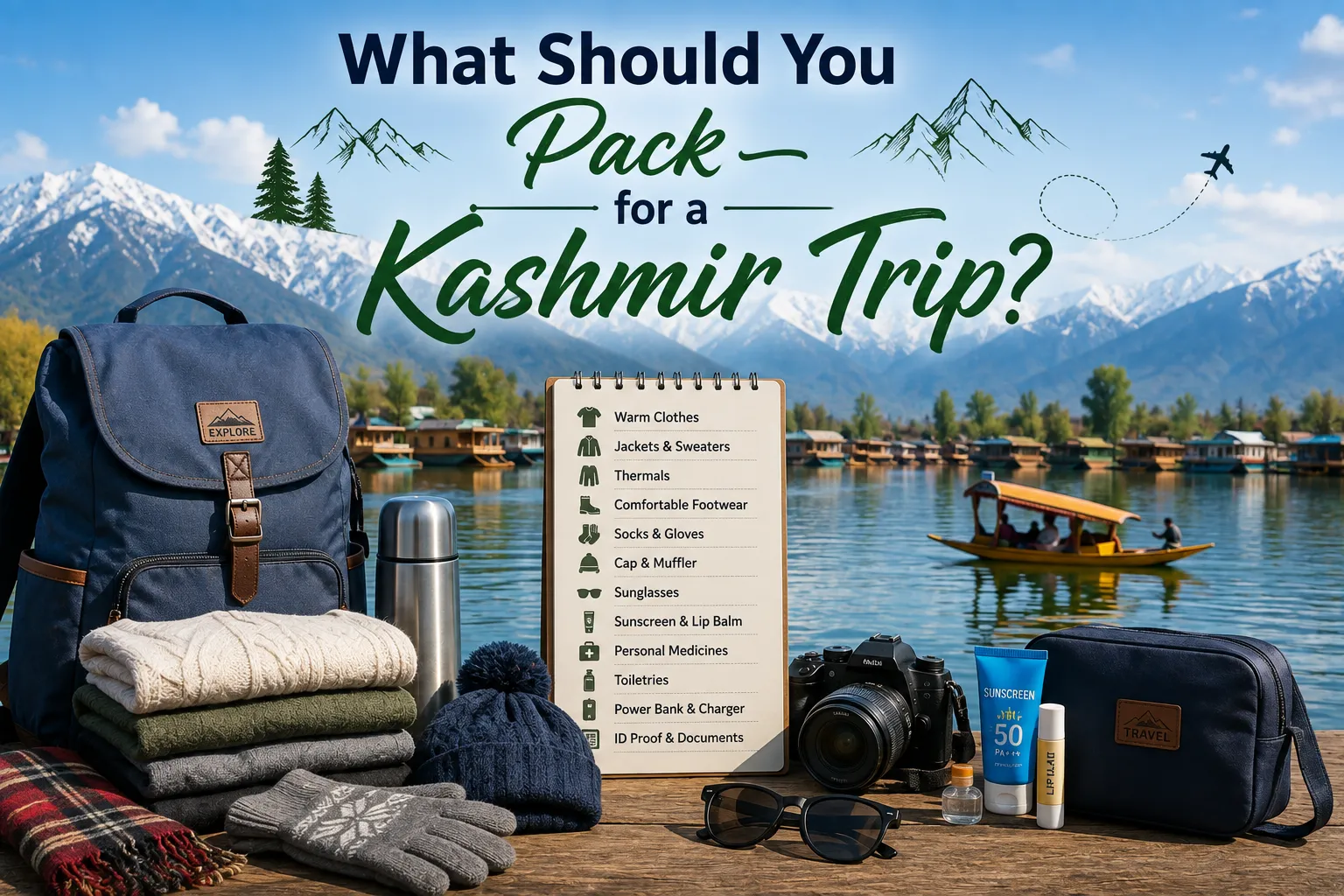
What Should You Pack for a Kashmir Trip?
Pack in layers, not for a single temperature — Kashmir's weather shifts more between morning and afternoon, and between Srinagar and Gulmarg, than it does across most single-season trips in India. A summer day in Srinagar can touch 30°C by afternoon and drop to 15°C by evening on the water; the same week, Gulmarg's meadows sit 10–15°C cooler than Srinagar simply from elevation. Winter is the other extreme: Srinagar nights regularly fall to -2°C to -6°C, and Gulmarg goes lower still, so "warm jacket" isn't specific enough — you need a system, not one item.
Here's what that system looks like by season, plus the items first-time travellers most often forget.
Planning a Kashmir Trip from Hyderabad?
Get a customized itinerary, package cost and travel assistance from Leisure Trips.
Packing List by Season
April–June (Spring/Early Summer)
- Light cotton clothing for daytime (Srinagar highs often reach 25–30°C)
- One medium-weight jacket or fleece for evenings and higher-altitude stops like Gulmarg or Sonmarg, where it's routinely 10°C+ cooler than Srinagar
- Closed-toe walking shoes — Mughal Garden paths and Gulmarg meadows are uneven, not paved
- Sunscreen and sunglasses — UV exposure is stronger at Gulmarg's elevation (~2,650m) than the plains, even when it doesn't feel hot
- A light raincoat or umbrella (May can bring sudden showers)
July–August (Monsoon)
- Quick-dry clothing over cotton — humidity is higher and rain is more frequent
- A proper rain jacket, not just an umbrella — the Sonmarg and Pahalgam roads can turn muddy, and you'll want your hands free
- Waterproof or water-resistant footwear
- A dry bag or zip-lock pouches for phones and documents during Shikara rides or outdoor sightseeing
September–November (Autumn)
- Layered clothing: a t-shirt or light shirt as base, a sweater or fleece mid-layer, and a windproof jacket for evenings — nights in Srinagar can dip below 10°C by late October
- A warm scarf or stole, useful both for warmth and for garden/shrine visits where covering up is appreciated
- Comfortable trekking-style shoes if you're doing Aru Valley or Betaab Valley walks, which have loose gravel sections
December–February (Winter/Snow)
- Heavy thermal base layers (top and bottom) — houseboats and some Pahalgam/Gulmarg hotels rely on room heaters or bukharis rather than central heating, so indoor temperatures can still feel cold at night
- A proper snow jacket, not just a thick sweater — Gulmarg nights average around -7°C, and daytime at higher gondola stations stays below freezing
- Waterproof snow boots with good grip — regular sneakers offer little traction on Gulmarg's packed snow and ice patches
- Woolen socks (at least 2 pairs, since wet socks in snow boots are hard to dry quickly on the road), gloves, and a woolen cap covering the ears
- Sunglasses or snow goggles — glare off snow at Gulmarg's altitude causes real eye strain by midday
- Moisturizer and lip balm — cold, dry mountain air chaps skin fast, more than most travellers from coastal or plains cities expect
What to Pack Regardless of Season
- A valid government photo ID (Aadhaar, passport, or driving licence) — required at hotel and houseboat check-in, and sometimes checked at Gulmarg Gondola boarding since the ticket name must match ID.
- Cash in smaller denominations. ATMs are reliable in Srinagar but sparse in Gulmarg, Pahalgam, and Sonmarg, and activities like Shikara rides, pony rides, and roadside stalls are typically cash-only.
- A basic medical kit with altitude-relevant items — paracetamol, motion sickness tablets for the winding Pahalgam/Sonmarg roads, and any personal prescriptions, since well-stocked pharmacies are harder to find outside Srinagar.
- A power bank. Houseboats and some Gulmarg properties have limited plug points per room, and cold weather drains phone batteries faster than usual.
- A daypack for carrying layers, water, and camera gear on day trips — you'll be adding and removing jackets multiple times a day as you move between Srinagar and higher elevations.
What You Don't Need to Pack
- Heavy hiking boots for a standard 5–6 day sightseeing itinerary. Unless you're doing a dedicated trek (Kashmir Great Lakes, for instance), sturdy walking shoes are enough — full trekking boots are extra weight for terrain most itineraries don't actually cover.
- Formal wear. Kashmir's itinerary is outdoor and casual almost throughout; smart-casual layers cover every occasion, including houseboat dinners.
- A full snow suit rental substitute if you're only visiting in summer — Gulmarg's summer temperatures rarely justify more than a fleece, even at the gondola's upper station.
Frequently Asked Questions
What is the best way to plan a Kashmir trip?
Decide your season before you shop for a packing list, since a Kashmir packing list for April and one for January share almost nothing beyond a daypack and ID — packing for "cold mountains" in general terms, instead of your specific travel month, is the easiest way to end up either over-packed or under-prepared.
How do I book a Kashmir tour package?
Once your dates are fixed, ask your operator for the expected temperature range on your specific travel days, not just the season name — "October" can mean anything from a mild 20°C afternoon to a first-snow week, and that changes your packing list materially.
Is it better to book Kashmir online or through an agency?
For packing questions specifically, a local agency or your houseboat/hotel host can tell you same-week conditions (recent snowfall, road status, whether heating is included) that generic online packing lists can't, since Kashmir's weather can shift meaningfully within a single travel week.
Still Unsure What to Pack for Kashmir?
Tell us your travel month and destinations, and we'll help you understand what to carry based on the expected conditions.
Talk to Someone Who Knows the Season You're Traveling In
A packing list is only as good as the weather forecast behind it — before you start shopping for thermals or rain gear, get a sense check from someone tracking Kashmir's conditions right now.
Talk to a Kashmir Travel Expert Before You Pack
Explore our Kashmir tour packages, see all destinations we cover, or read our complete guide to Kashmir tour packages for season-by-season itinerary planning.


Suresh
We, colleagues had a trip in Kerala. We shared our plan details with Leisure trips. They planned our tour very perfectly. They got hardly 3 days to plan. But in that very short time, they responded to us, planned so good. Stay, site seeing, food everything was good. We really had a great time. We wish to choose Leisure trips again.
Pavithra Lakshmana
I would like to thank Leisure Trips for organizing such a wonderful tour package to Wayanad. The team's regular follow-ups and prompt support throughout the trip made the entire experience smooth and enjoyable. A special mention goes to our stay at Seagot Banasura, which truly exceeded our expectations. Thank you for making our trip memorable. We look forward to traveling with Leisure Trips again.
Faizaan Zameer
Had a very good experience with Leisure Trips Tour and Travels for our Kashmir trip. Everything was arranged nicely and the trip went smoothly from start to end. Special thanks to Mr. Muzammil for his support and service throughout the trip. He was always available to help, responded quickly, and made sure all the arrangements were taken care of properly. Because of his coordination, our trip was comfortable and hassle-free. Thank you to Leisure Trips and Mr. Muzammil for making our Kashmir trip memorable. Highly recommended.
Rama Krishna
We had an amazing trip to Shimla and Manali with excellent planning and smooth arrangements throughout. The hotels were comfortable, clean, and located in beautiful surroundings. The sightseeing itinerary was well-organized, allowing us to enjoy all the major attractions without any hassle. The travel team was professional, supportive, and always available to assist whenever needed. Overall, it was a memorable and enjoyable experience, and I would highly recommend this trip to others.
Himani
The entire tour was organized professionally. We didn't have to worry about anything during our vacation❤