


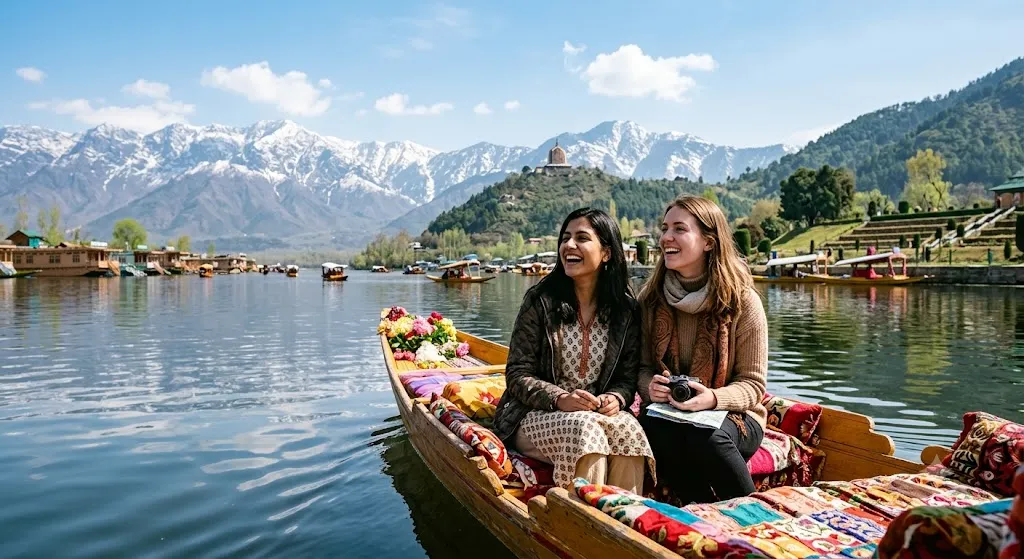
Where Can One Visit in Srinagar Over Two Days?
Over two days, Srinagar's must-visit list comes down to five places: Dal Lake (for a Shikara ride and, ideally, a houseboat stay), the Mughal Gardens — Nishat Bagh, Shalimar Bagh, and Chashme Shahi — Shankaracharya Temple for the best skyline view in the city, and the Old City around Jama Masjid for markets, mosques, and craft workshops. It's tight — you won't have time for a Gulmarg or Pahalgam day trip alongside this — but these five stops cover Srinagar's water, hills, and old-city sides well enough that 2 focused days don't feel rushed if you sequence them by geography rather than by a generic must-see list.
Here's how to structure both days, with the practical details — timings, entry fees, distances — that decide whether the plan actually works on the ground.
Day 1: Dal Lake and the Mughal Gardens
Morning: Dal Lake by Shikara
Start early — 6:30 to 8 AM is when Dal Lake is calmest and least crowded, and it's also when the floating vegetable market operates near the Ghat, if you want to see it. A Shikara ride (roughly ₹600–₹1,200 for an hour, depending on route and season) takes you past the floating gardens, houseboat rows, and Char Chinar island. If you're staying on a houseboat, this can double as your transfer in or out for the day rather than a separate booked activity.
Late Morning: Mughal Gardens
Srinagar's three main Mughal gardens sit within a short drive of each other and of Dal Lake:
- Nishat Bagh — the larger of the two main gardens, terraced with views back across Dal Lake toward the Zabarwan hills.
- Shalimar Bagh — built by Emperor Jahangir in 1619, with a straight central water channel running through its terraces and a black marble pavilion at the top. Entry is a nominal ₹24 per person, and it's open 9 AM to 7 PM (closing earlier, around 6 PM, in winter).
- Chashme Shahi — the smallest of the three, built around a natural spring said to have some of the purest water in the valley. It only needs about 30 minutes but is worth the stop if you're already driving past.
Since shared cabs between these gardens can be inconsistent — easy to find between Nishat and Shalimar, harder for Chashme Shahi or Pari Mahal — a private half-day cab for garden-hopping (roughly ₹1,500–₹2,000) is usually more reliable than trying to piece together local transport on a tight 2-day schedule.
Afternoon: Lunch and Rest
Kashmiri Wazwan is the dish to try if you haven't already — Rogan Josh and Yakhni are the two most approachable dishes for a first-time visitor, both available at most mid-range Srinagar restaurants without needing to book the full multi-course Wazwan experience. Use this slot to rest before the evening, since Day 1's second half involves a hill climb.
Evening: Shankaracharya Temple
Perched on Shankaracharya Hill at roughly 1,100 feet above the city, this is the single best sunset viewpoint over Dal Lake and the Srinagar skyline. A few practical notes that first-time visitors often miss:
- It's a working security checkpoint area — expect an ID check and a walk up a flight of stairs from the parking area, since vehicles aren't allowed all the way to the top.
- Photography inside the temple itself is typically restricted; the walk up and the view from outside are where most people take photos.
- Go about an hour before sunset — the climb and the crowd both move faster than expected once the light starts turning.
Day 2: Old City and Local Craft
Morning: Jama Masjid and the Old City
Srinagar's Old City is where the 2-day itinerary earns its second day — most short itineraries skip it entirely and default to a second lake or garden visit, which means missing the city's actual historic core.
- Jama Masjid — originally built in 1394 and rebuilt four times after fires, the current structure dates to 1674. Its prayer hall is supported by 378 wooden pillars, each carved from a single deodar tree, with a stated capacity of 33,000 worshippers. Non-Muslims are welcome to visit outside prayer times; a Friday afternoon visit shows the mosque at its most active, though that's also when it's least convenient for sightseeing.
- Khanqah-e-Mualla (Shah Hamdan Shrine) — a short walk from Jama Masjid, known for its carved wooden facade and papier-mâché ceiling work, both examples of the same craft techniques sold in the markets nearby.
Walking between these two sites also takes you past working papier-mâché and wood-carving workshops in the surrounding lanes — worth 15–20 minutes even if you're not buying, since it's where you'll understand what you're actually looking at if you shop later.
Afternoon: Shopping — Lal Chowk and Polo View Market
- Polo View Market is the more organized, fixed-price option for Pashmina shawls, saffron, and dry fruits, generally more reliable for first-time buyers than roadside stalls near tourist spots.
- Lal Chowk is Srinagar's central commercial hub — better for a broader browsing experience and local snacks, less curated than Polo View.
- For Pashmina specifically, ask for a burn test or a rub test if the seller offers it — genuine Pashmina is a common target for overpricing and mislabeling with cheaper wool blends, and a reputable shop won't hesitate to demonstrate.
Evening: Houseboat Dinner or a Second Shikara
If you haven't done a sunset Shikara yet, this is the better evening for it — Day 1's evening was committed to Shankaracharya, so a second lake outing on Day 2 rounds out the trip without repeating the same activity twice. Alternatively, a houseboat-hosted dinner is a quieter way to close a 2-day trip, particularly if your onward travel the next morning is early.
How to Get Around Srinagar in 2 Days
For a 2-day itinerary specifically, a private cab booked for both days (rather than per-trip local transport) is the more time-efficient choice — Srinagar's sightseeing points are spread across the city rather than clustered, and local shared-cab availability is inconsistent enough that it can eat into a tight schedule. Expect to pay roughly ₹1,500–₹2,500 per day for a private cab covering garden visits, Shankaracharya, and Old City transfers, separate from your Shikara costs.
If You Only Have 1.5 Days (Flight Timing Adjustment)
A common real-world constraint: an afternoon arrival on Day 1 and a morning departure on Day 2. If that's your situation:
- Skip Chashme Shahi and keep Nishat Bagh and Shalimar Bagh only — they're closer to each other and to Dal Lake.
- Move Shankaracharya Temple to Day 1 evening regardless of arrival time, since it's the one stop most affected by daylight.
- Keep the Old City walk on Day 2 morning but drop the shopping stop if your flight is early — Polo View and Lal Chowk are both easy to fold into a longer Kashmir trip later if you're continuing on to Gulmarg or Pahalgam.
Best Time of Year for a 2-Day Srinagar Trip
Srinagar works as a short trip in almost any season, unlike Gulmarg or Sonmarg where road and weather conditions can cancel a day entirely:
- April–May: Tulip Garden season (if your dates align) and the Mughal Gardens are at their most colorful with iris and tulip displays.
- September–November: Clearer skies, better visibility from Shankaracharya, and Chinar trees turning color in the gardens by late October.
- December–February: Cold but manageable for a city-based itinerary since none of Day 1 or Day 2 here requires the higher-altitude travel that winter disrupts elsewhere in Kashmir.
What to Eat Across Your 2 Days
Kashmiri cuisine has enough range that you don't need to commit to a full Wazwan banquet to get a real sense of it in 2 days:
- Rogan Josh — the most widely available Kashmiri mutton dish outside Kashmir too, so it's a good benchmark dish to try locally and compare.
- Yakhni — a yogurt-based mutton curry, milder and less commonly found outside the valley, worth trying specifically because it's harder to get elsewhere.
- Nadru Yakhni or Nadru Monje — lotus stem cooked in yogurt gravy or as fritters, a good vegetarian option that's distinctly Kashmiri rather than a generic North Indian substitute.
- Modur Pulao — a mildly sweet saffron rice, usually served as part of a larger meal rather than ordered alone.
- Kahwa — the traditional saffron-cardamom-almond green tea, worth having at least once from a roadside stall rather than only a hotel version, since preparation style varies noticeably.
If you want the full multi-course Wazwan experience (typically a 7-course or larger spread centered on meat preparations), it generally needs to be arranged in advance through your hotel or a dedicated Wazwan restaurant — it's not something you'll casually order at a regular meal stop, and most 2-day itineraries fit it in as a single dedicated dinner rather than a repeated meal.
Practical Tips Before You Go
- Mobile connectivity: Prepaid SIM cards from outside Jammu & Kashmir typically don't work in the valley due to regional telecom restrictions — postpaid connections generally work, and BSNL/local prepaid options are available on arrival if needed. Don't rely solely on your home-state prepaid SIM for navigation or bookings during the trip.
- Cash access: ATMs are reliable in central Srinagar (Lal Chowk, Dal Gate area) but withdraw what you need for the full 2 days early, since smaller sightseeing stops and Shikara operators are cash-first.
- Photography at religious sites: Beyond Shankaracharya Temple, Jama Masjid and Khanqah-e-Mualla also have informal or posted restrictions on photography inside prayer areas — ask before shooting rather than assuming it's allowed everywhere a mosque or temple permits entry.
- Security checkpoints: Occasional ID checks near government buildings, bridges, and the Shankaracharya route are routine rather than trip-specific — carrying a physical photo ID (not just a phone photo of one) saves time at these points.
- Local guide value: For a 2-day trip specifically, a local guide adds more value in the Old City (navigating lanes, explaining craft techniques, knowing which workshops welcome visitors) than at the more straightforward Mughal Gardens or Dal Lake stops, where signage and Shikara operators already provide context.
Frequently Asked Questions
What is the best way to plan a Kashmir trip?
If Srinagar is a standalone 2-day trip rather than the start of a longer Kashmir itinerary, book your houseboat or hotel first and build sightseeing around its location on the lake — Dal Lake–side stays cut significantly more travel time than a city-center hotel would for this specific itinerary.
How do I book a Kashmir tour package?
For a Srinagar-only itinerary, confirm with your operator whether the private cab for both days is included or charged separately, since a 2-day city itinerary has more stop-to-stop transfers than a typical multi-city Kashmir package and cab costs can add up differently.
Does Leisure Trips offer customized Kashmir itineraries?
Yes — a 2-day Srinagar-only itinerary can be booked on its own or extended into a full Kashmir circuit (Gulmarg, Pahalgam, Sonmarg) depending on how many days you have; the Day 1/Day 2 structure above works as a standalone trip or as the opening two days of a longer package.
Ready to Explore Srinagar?
Two days go fast once you're on the ground — a guided itinerary keeps the timing tight so you're not losing daylight to transport logistics.
Explore our Kashmir tour packages, browse all destinations we cover, or read our complete guide to Kashmir tour packages if you're extending this into a longer Kashmir trip.


Suresh
We, colleagues had a trip in Kerala. We shared our plan details with Leisure trips. They planned our tour very perfectly. They got hardly 3 days to plan. But in that very short time, they responded to us, planned so good. Stay, site seeing, food everything was good. We really had a great time. We wish to choose Leisure trips again.
Pavithra Lakshmana
I would like to thank Leisure Trips for organizing such a wonderful tour package to Wayanad. The team's regular follow-ups and prompt support throughout the trip made the entire experience smooth and enjoyable. A special mention goes to our stay at Seagot Banasura, which truly exceeded our expectations. Thank you for making our trip memorable. We look forward to traveling with Leisure Trips again.
Faizaan Zameer
Had a very good experience with Leisure Trips Tour and Travels for our Kashmir trip. Everything was arranged nicely and the trip went smoothly from start to end. Special thanks to Mr. Muzammil for his support and service throughout the trip. He was always available to help, responded quickly, and made sure all the arrangements were taken care of properly. Because of his coordination, our trip was comfortable and hassle-free. Thank you to Leisure Trips and Mr. Muzammil for making our Kashmir trip memorable. Highly recommended.
Rama Krishna
We had an amazing trip to Shimla and Manali with excellent planning and smooth arrangements throughout. The hotels were comfortable, clean, and located in beautiful surroundings. The sightseeing itinerary was well-organized, allowing us to enjoy all the major attractions without any hassle. The travel team was professional, supportive, and always available to assist whenever needed. Overall, it was a memorable and enjoyable experience, and I would highly recommend this trip to others.
Himani
The entire tour was organized professionally. We didn't have to worry about anything during our vacation❤